
Last updated October 16, 2026
 AC repair
 Furnace & heating
 Heat pumps
 Ductless mini splits
 Carrier
 Trane
Trane Goodman
Seasonal tune-up and full diagnostic on your Carrier, Trane, or Goodman system - readings shown to you before any repair is proposed
Diagnosis first, numbers second - you approve the repair price before a single part goes in.
Get your free estimateHVAC Permits, Codes & Inspections in FL: What You Need to Know
If you bought a Tampa home in the last five years, there’s a meaningful chance the AC was replaced without a permit – a fact your inspector may have missed and that your insurance company will not overlook when you file a claim. Florida’s permitting process is not just paperwork. It is the legal record that proves your system was installed to code, by someone qualified, and inspected by the county. Skip it, and you inherit the liability. This guide walks through exactly when a permit is required in Tampa and Hillsborough County, how to check whether your current system was ever permitted, what an inspector actually looks at, and what happens when unpermitted work surfaces during a sale or an insurance claim. For more guides & resources on protecting your home, see our blog.
Quick Answer
In Florida, a permit is legally required for any HVAC work that involves new equipment installation, full system replacement, or duct modification. Repairs like capacitor swaps, fan motor replacements, coil cleanings, and refrigerant recharge typically do not require a permit in Hillsborough County. If your current AC was replaced without one, you may face issues during a home sale or insurance claim, and the fix is usually a retroactive permit and inspection.
Styles & brands we work with
Table of Contents
- When a Permit Is Required in Florida (and When It Isn’t)
- Hillsborough County Code: What Tampa Homeowners Need to Know
- How to Check If Your HVAC Was Ever Permitted
- What a Florida HVAC Inspection Actually Checks
- The Real Cost of Unpermitted HVAC Work: Insurance and Home Sales
- What to Say When a Contractor Suggests Skipping the Permit
- How to Fix Unpermitted HVAC Work After the Fact
When a Permit Is Required in Florida (and When It Isn’t)
Florida building code is clear about this, even if enforcement varies by county. Under Florida Statute 489.103 and the Florida Building Code, any mechanical work that involves changing the structure, altering ductwork, or installing new equipment requires a permit pulled by a licensed contractor. The permit exists to create a paper trail that proves the work was done to code and inspected by the county. Without it, you have no legal record that the job was done correctly.
Here is the breakdown of what does and does not require a permit in Hillsborough County:
Work That Requires a Permit
- Full system replacement: Replacing the entire condenser and air handler counts as an installation, not a repair. A permit is required every time, and the county must inspect the finished job.
- New equipment installation: Adding a completely new AC system to a home that did not previously have one, or installing a new unit in a newly built addition, always requires a permit.
- Duct modification: Any time a contractor alters, replaces, or extends ductwork, the county requires a permit. This includes reconfiguring supply runs, adding new vents, or replacing a full duct system.
- Electrical panel upgrades tied to HVAC work: If your new system requires an upgraded circuit or a new disconnect box, the electrical work must be included in the permit scope.
Work That Does NOT Require a Permit
- Filter changes: Replacing a standard air filter is routine maintenance with no permit requirement.
- Coil cleaning: Evaporator and condenser coil cleaning is considered maintenance, not installation.
- Refrigerant recharge: Adding refrigerant (topping off the coolant your system needs to produce cold air) is a repair function and does not require a permit, though it should be done by an EPA-certified tech.
- Component replacement: Capacitors, contactors, fan motors, thermostats, and control boards are replacement parts, not new installations. No permit needed in Tampa for these repairs.
What surprises most Tampa homeowners is how broadly “installation” is defined. We’ve had calls from homeowners who assumed a full system changeout was just a bigger repair. It is not. Once you remove the old condenser and air handler and install new equipment, that is legally an installation in Florida, and a permit is mandatory. For any repair work in the Tampa area, our team at AC Repair in Tampa can confirm whether your specific situation requires a permit before any work begins.
Hillsborough County Code: What Tampa Homeowners Need to Know
Hillsborough County follows the Florida Building Code with local amendments, and the county requires mechanical permits for HVAC installations to be pulled by a licensed contractor. The permit must be displayed on the job site, and an inspection must be scheduled after the work is complete. This applies whether you live in South Tampa, Westchase, Carrollwood, Riverview, or Brandon – the permitting requirements are county-wide, not city-specific.
Tampa’s climate adds a layer most national guides miss. The high humidity, heavy rainfall, and salt air near the bay mean that installation errors compound faster here than in drier climates. A condenser pad set incorrectly can sink after one rainy season. An improperly sloped condensate drain will clog within months in Tampa’s humidity. Ductwork with air leaks in an unconditioned attic pulls in 120-degree air all summer, forcing your system to run longer. These are exactly the issues a HVAC Warning Signs: A Tampa Homeowner’s Reference Guide and a Hillsborough County inspection are designed to catch.
Here is a plain-English explanation of what the county inspector’s role is: the inspector works for the county, not the contractor. Their job is to verify the work meets code before the permit is closed. If a contractor skips the permit, that independent check never happens. You are left trusting that the installer did it right, with no third-party verification. For Tampa homeowners, that is a bigger risk than most realize because of how hard our systems work from May through October. See our Seasonal HVAC Care for Tampa: Year-Round Homeowner’s Guide for how to protect your system during peak months.
How to Check If Your HVAC Was Ever Permitted
The Hillsborough County property appraiser and permit portal maintain public records for every address in the county. Checking your own home is free and takes about ten minutes. This is worth doing whether you just bought the home or have lived there for years, because discovering unpermitted work now is far less expensive than discovering it during an insurance claim or a sale.
Here is the step-by-step process:
- Go to the Hillsborough County permit search portal. Search “Hillsborough County permit search” or use the HillsGovHub online permit lookup tool. You will need your street address or parcel number.
- Enter your address and review the permit history. The portal lists every permit ever pulled for your property, including mechanical, electrical, plumbing, and roofing. Look for any permit labeled “mechanical” or “HVAC” with an approval date that matches when your system would have been installed.
- Cross-reference the permit dates with the age of your AC unit. Most condensers have a data plate on the side with the manufacture date. If your unit was manufactured in 2019 but there is no mechanical permit from 2019 or 2020 on the portal, that is a red flag that the system was installed without one.
- Verify the permit status. A permit that is still “open” means the work was started but never passed a final inspection. A permit marked “closed” or “finaled” means the work was inspected and approved.
- If nothing appears, call the county. The Hillsborough County permitting office can run a search for you if the online portal is unclear. Ask specifically about mechanical permits for your address.
We have walked many Tampa homeowners through this exact check after they called us for a repair and we noticed their unit’s age did not match the permit history. It takes one phone call or portal search to know where you stand. If the system was never permitted, you will want to know that before you file an insurance claim or list the home for sale. For homeowners whose systems are on their last leg, our AC Installation in Tampa team handles permitting on every new system install, pulling the permit, scheduling the inspection, and closing it out with the county.
What a Florida HVAC Inspection Actually Checks
When a contractor pulls a permit for HVAC work in Hillsborough County, the county schedules an inspection after the job is complete. The inspector arrives on-site to verify the installation meets the Florida Building Code. If it does not, the contractor must correct the issue and schedule a re-inspection. Only after the inspector signs off does the permit close.
Here is what a typical mechanical inspection covers:
- Equipment placement and clearance: The condenser needs proper clearance on all sides for airflow, and it cannot be placed under a deck or in an enclosed area. The inspector checks that the unit sits on a stable, level pad that will not sink into Tampa’s sandy soil.
- Electrical connections: The inspector verifies the disconnect box is properly sized, the wiring is correctly rated, and the system is grounded. Improperly sized breakers or loose connections are common findings on unpermitted jobs.
- Refrigerant line set: The copper lines running between the condenser and air handler must be properly sized, insulated, and secured. Leaks or undersized lines force the compressor to work harder and fail sooner.
- Condensate drainage: In Tampa’s humidity, the condensate drain must be properly sloped, trapped, and routed to an appropriate location. An improperly installed drain floods attics and ruins drywall. This is one of the most common failure points inspectors catch.
- Duct connections: The inspector checks that ducts are sealed, supported, and properly connected to the air handler. Leaking ducts waste conditioned air and pull attic heat into the system.
- Code-specific requirements: Hillsborough County enforces specific requirements for hurricane straps on rooftop equipment, wind-load ratings that account for Tampa’s storm exposure, and secondary drain pan requirements for attic installations.
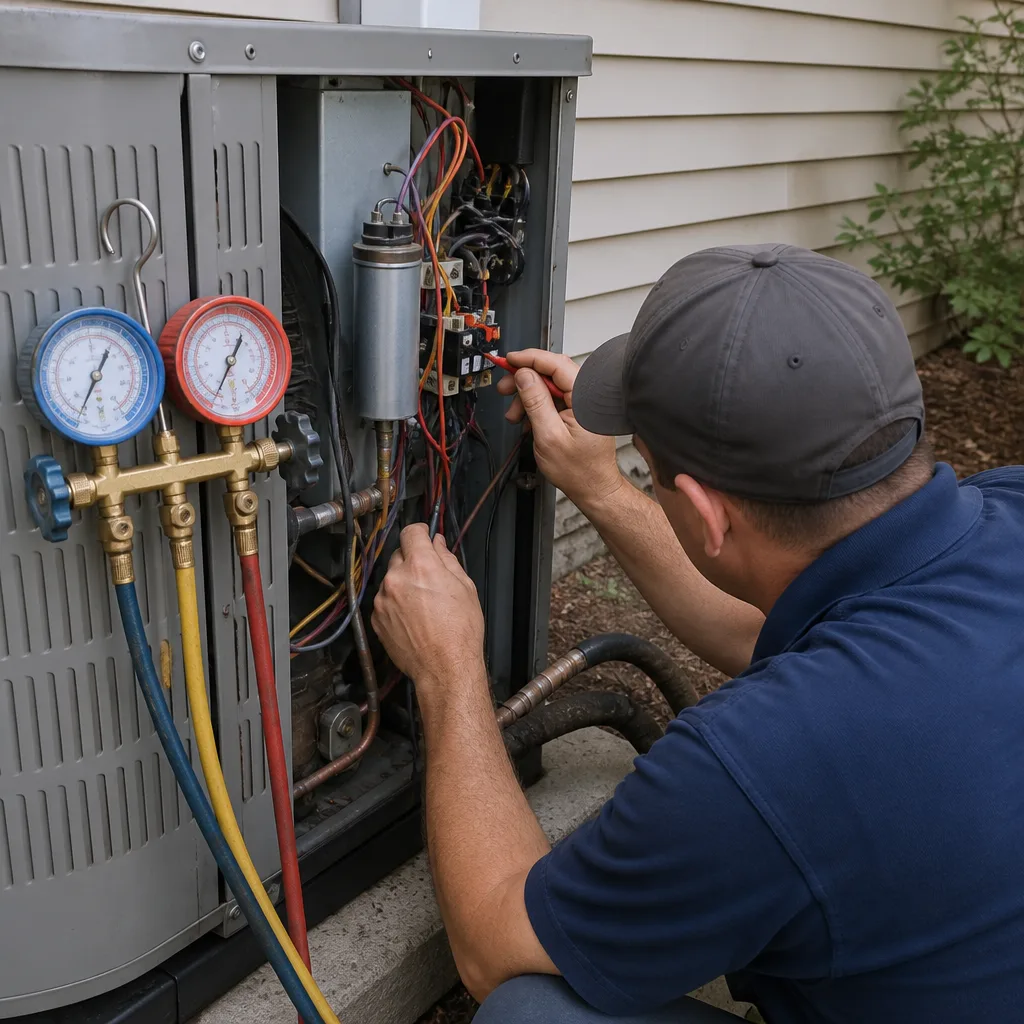
The inspection is not a formality. Contractors who routinely skip permits often cut corners on exactly these items because no one is checking their work. When a homeowner then calls us for a repair and we open the air handler, we sometimes find undersized duct connections, missing float switches, or a condensate line draining into a soffit. These are the kind of errors a $75 county inspection would have caught, and they are the reason Halden Heating and Air Tampa home handles permit paperwork on every qualifying install and repair we do.
The Real Cost of Unpermitted HVAC Work: Insurance and Home Sales
This is where we see the most expensive surprises. Unpermitted HVAC work rarely causes a problem while the system is running fine. The problem appears when something goes wrong and the insurance company gets involved, or when a home goes under contract and a diligent buyer’s inspector starts pulling records.
Here is a scenario we have seen play out in Tampa more than once: a homeowner files a claim for water damage caused by an AC condensate leak. The insurance adjuster asks for the permit history on the system. There is no permit. The claim is denied, and the insurer’s position is that unpermitted work is uninsurable work. The homeowner is now paying out of pocket for the water damage, and they still have an unpermitted system that needs to be permitted and inspected before any future claim will be honored.
Home sales are where unpermitted HVAC work becomes a full-blown problem. In Tampa’s market, buyers are increasingly pulling permit histories during the inspection period. If the permit history shows no mechanical permit for a system that is clearly newer than the home, a buyer can demand the seller resolve it before closing. In multiple cases we have seen, that resolution meant removing and reinstalling a perfectly working system just to get the permit and inspection completed. That is a $6,000 to $12,000 problem on a system that produced cold air every day.
The liability does not end at closing, either. If a buyer discovers the unpermitted system after closing, the seller can be held responsible for failing to disclose known issues. Courts have ordered sellers to pay for full re-installation when unpermitted work was discovered post-sale. The paper trail matters. In our experience, roughly one in four Tampa homes we service has at least one major system that was never permitted. The previous owner saved a few hundred dollars on permit fees, and now the current owner holds the liability.
What to Say When a Contractor Suggests Skipping the Permit
Every homeowner should know this before the conversation happens, because it is more common than most realize. A contractor suggests skipping the permit “to save time” or “to save you a few hundred dollars.” What they are really saving is their own accountability. Without a permit, there is no county inspection, no independent verification of their work, and no legal record that the job was ever done.
Here is exact language you can use if this happens:
“I need this work permitted. Pull the permit, schedule the inspection, and close it out. If that’s not something you do, I’ll find someone who will.”
That is the full conversation. A legitimate contractor will say, “No problem, the permit fee is included in the price.” A contractor who pushes back or tries to talk you out of it is telling you something important about how they run their business. A licensed contractor who pulls permits daily is not slowed down by the process. The permit application is completed online, the fee is nominal, and the inspection is scheduled after the work is done. There is no legitimate reason to skip it.
Here is what we have learned after years of working in Tampa: a company that offers a locked written price before the work starts has no incentive to skip permits. The permit is a fixed cost. The inspection is a scheduled step. Our process at Halden Heating and Air Tampa is straightforward: every qualifying install includes the permit, the county inspection, and the closed permit record delivered to you. No exception. A company quoting a lower price by skipping permits is not cheaper. They are passing the cost to you in the form of liability you hold for years. If a repair on your heat system ever goes sideways, our Furnace Repair in Tampa team follows the same rule: permitted when required, paper trail always.
How to Fix Unpermitted HVAC Work After the Fact
If you checked the Hillsborough County permit portal and discovered your system was never permitted, you are not stuck. The county has a process for this, and while it involves time and money, it is far cheaper than the alternative of dealing with an insurance denial or a failed home sale.
Here is the step-by-step process to bring an unpermitted system into compliance:
- Hire a licensed Florida HVAC contractor. The retroactive permit must be pulled by a licensed contractor. This cannot be done by the homeowner, even if the work was originally done by the previous owner.
- The contractor applies for a retrofit or “after-the-fact” permit. Hillsborough County processes these through the same HillsGovHub portal. The contractor submits the application describing the existing installation.
- Schedule an inspection. The county inspector will evaluate the existing system as-is. If the installation meets code, the inspector approves it, and the permit closes. If there are violations, the contractor must correct them before re-inspection.
- Correct any code violations found. Common violations we see corrected on after-the-fact permits in Tampa include improper condensate drainage, missing hurricane straps, insufficient electrical clearance, and uninsulated refrigerant lines.
- Receive the closed permit. Once the inspector signs off, the permit is closed. You now have a legal record that your system was inspected and approved. Keep this document. You will need it if you sell the home or file an insurance claim.
The cost for a retroactive permit is typically the same as a standard mechanical permit, plus any corrections needed to bring the system up to code. In Tampa, that typically runs between $150 and $800 depending on what the inspector finds. It is a small price relative to the $6,000 to $12,000 cost of a forced re-installation during a home sale, or a denied insurance claim for water damage from a failed condensate line. We have helped many Tampa homeowners through this process after they discovered an unpermitted system during a AC Repair Maintenance Checklist for Tampa Homeowners visit, and the resolution is almost always smoother than they expect.
One other note that matters for Tampa homeowners specifically: major brands like Daikin, York, Bryant, and American Standard typically will not honor a warranty claim on an unpermitted installation. The manufacturer’s warranty terms require installation by a licensed contractor, and a permit is the standard proof of that. So an unpermitted system can leave you without parts coverage and without insurance coverage, even while the system itself works fine. That is a triple exposure most homeowners never think about until a compressor fails four years in.
Common Mistakes to Avoid
- Assuming a home inspection catches unpermitted HVAC work. Most home inspectors check that the AC blows cold. They do not pull the county permit history. Buyers in Tampa regularly close on homes with unpermitted systems that surface months or years later.
- Trusting the previous owner’s word without checking the portal. A seller may genuinely believe the work was permitted. The only way to know is to search the Hillsborough County permit records for your address. Ten minutes online tells you what you need to know.
- Treating a “repair” as a permit-free loophole for what is really an installation. Swapping a condenser and air handler is an installation, not a repair, no matter what the invoice says. The county defines the work by what was done, not what the contractor called it.
- Ignoring an open permit on your property. An open permit means the work was started but never passed final inspection. This shows up in title searches and can delay or kill a home sale. Close it out before you list.
- Paying a smaller deposit to a contractor who “handles permits on their end” without receipts. If the contractor cannot show you the permit number and the scheduled inspection date, do not assume it was pulled. Verify it yourself on the Hillsborough County portal.
- Waiting until a system fails to check the permit history. The worst time to discover unpermitted work is the day you file an insurance claim. Check your permit status today, while the system is still running, and take care of it before you have a problem.
- Choosing a lower quote over a permitted install. A contractor who skips the permit is saving themselves time and creating liability for you. That is not savings. That is a deferred cost with interest.
See the difference
 Before
 After
After Before
 After
After Before
 After
AfterWhen to Call a Professional
Bring a licensed contractor in whenever you are buying or selling a home and the permit history on the HVAC system is unclear, or whenever you know the system was never permitted and you want to resolve it before it becomes a problem. The same goes for any install that involves new equipment, duct modification, or after-the-fact corrections from unpermitted work. Halden Heating and Air Tampa offers free estimates in Tampa – call (850) 608-1463. We can check your permit history, explain what a retroactive permit involves, and give you a fixed written price for any corrective work before anything starts.
Frequently Asked Questions
Yes. A full system replacement is legally considered an installation under Florida building code, and Hillsborough County requires a mechanical permit pulled by a licensed contractor with a final inspection. Simple repairs like capacitor or fan motor replacement do not require a permit. Call (850) 608-1463 if you are unsure whether your specific job needs one, and we’ll tell you straight.
Search the Hillsborough County HillsGovHub permit portal by your street address, and look for mechanical permits with dates matching your system’s age. You can also call the county permitting office and ask for a permit history search for your address. If you find nothing and your system is newer than the home, the work was likely unpermitted.
You may face denied insurance claims for damage caused by the system, difficulty selling the home, and voided manufacturer warranty coverage. The fix is a retroactive permit pulled by a licensed contractor, followed by a county inspection that either passes the work or lists corrections that must be made. We help Tampa homeowners through this process regularly.
Mechanical permit fees in Hillsborough County typically run between $75 and $300 depending on the scope of work, with retroactive permits in the same range plus any correction costs the inspection identifies. Most contractors include the permit fee in their quote, so ask for it as a line item on any written estimate.
You can, but a diligent buyer or a title search may surface the missing permit, and the buyer can demand you resolve it before closing or reduce the price. Some sales have collapsed entirely over unpermitted HVAC work. Resolving it before you list is usually cheaper and faster than negotiating it under contract.
Typically not. Major brands including Daikin, York, and Bryant require installation by a licensed contractor, and a closed permit is the standard documentation proving that. An unpermitted install can leave you holding the full cost of parts that would otherwise be covered under warranty. Always confirm the permit was pulled and closed before you pay the final invoice on a new system.
The Bottom Line
Florida’s HVAC permit system exists to protect you, not to slow you down. A permit creates the legal record that your system was installed correctly, inspected by the county, and eligible for warranty and insurance coverage. Unpermitted work is a ticking liability that surfaces at the worst possible moments. In Tampa, where your AC runs hard for eight months a year and humidity punishes sloppy installation, the stakes are higher than most homeowners realize. Check your permit history. Demand a permit on any install. Keep the closed permit record with your home documents. That is the difference between a system you own and a system that owns you.
Written by Andre Fuller, Owner at Halden Heating and Air Tampa, serving Tampa since 2004.